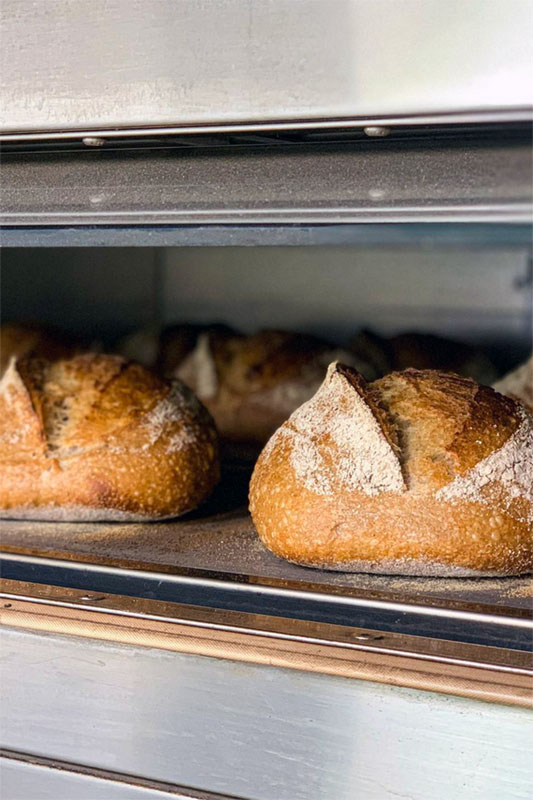
Sample Lesson: Sourdough Baking Course
It’s really easy to start your own sourdough mother, and it’s like growing your own pet that will require feeding and minding. It simply requires flour, water and time.
What flour to use?
You can start a mother (culture) with most flours, but make sure to choose a flour that is easy to come by, is not that expensive, as the mother will require regular feeding. We use a white flour-based mother culture in our bakery, and I also have a wholemeal spelt mother at home.
A white flour will have more sugars available and less fibre than a wholemeal flour, so the mother will grow quicker and therefore require more regular feeding. Wholemeal flour has a higher fibre content, so it will absorb more moisture and be slightly less active than white flour.
Method
In a 400-ml clean jam jar, add:
- 50g of flour of choice (we prefer 100% wholewheat or wholemeal spelt)
- 50 ml of water
Mix well until homogenous. Cover with a tea towel to stop flies from entering while still allowing air and natural yeast to enter.
Leave it to sit on the countertop for 3-5 days out of direct sunlight.
Once it smells yeasty and slightly beer-like or brewery-like and has small bubbles in it, it is ready to go and get its first feed. You now have your very own sourdough mother to love and look after, which will hopefully nourish you and your friends and family!
It is important to note that whatever flour your mother culture was created with is the flour you will always have to feed it, so for example, if you used wholemeal spelt flour, then your mother culture needs to always be fed wholemeal spelt flour. You can change the type of flour over time, but this is a gradual process.
Feeding your new mother culture
Your sourdough culture will now need to be fed daily. If you are going on holiday, either get a friend to feed it or simply put it in the fridge, and it will live for a week without feeding (when starting to bake from using your mother from the fridge, it will require 1 good feed before baking once out of the fridge to get it active for baking bread).
Pour out half of your mother culture into a bowl; this will be used to make bread. Now in the same jar, add:
- 50g flour (ensure it is the same flour as your mother culture was created with)
- 50 ml of water
Mix well, and leave.
How regularly should I feed my mother?
If your mother is living outside of the fridge, it will need to be fed daily. If it is in a warm environment, such as 20 degrees C, it might need to be fed twice daily. If your mother is living in the fridge, it will need to be fed weekly or, at a stretch, every second week.
If your mother is living in a cold environment, such as a kitchen in winter that is approx. 5 degrees C, it will need to be fed once per week, as this environment is similar to a fridge.
Sample Lesson: Gut Health – Why all health begins in the gut
In medicine we have known that gut health is crucial to overall health for a very long time. Over 2 thousand years ago, Hippocrates “the father of modern medicine”, taught his students that all health begins in the gut.
In 21st century we now recognise there was so much truth in that. We have learnt this through unlocking the secret world of the human gut microbiome.
When we are born, from our first human breath to our first human touch; the microbes in the environment populate our bodies and our digestive system.
They help us to digest our first meal, without them our intricate digestive system would not even develop properly, nor would our immune system.
By adulthood, this microbiome has grown to an impossibly complex ecosystem, found predominantly in our large bowel or colon. Made up of over 100 trillion microbes, bacteria, yeasts, viruses, and archaea. They have been described as a control centre for human biology. Interacting with the food we eat, each other, and the delicate lining of our digestive system.
The microbe that exist in us are descendants from the planets first inhabitants, they have been on the earth for thousands and thousands of years.
Your gut microbes outnumber the trees on planet earth, in fact they outnumber all the stars in the Milky Way! We are equal parts human and microbes, in fact our gut microbes contain far more genetic material than our human cells.
Our microbes produce dozens – if not hundreds of chemicals that interact with our body, enter our bloodstream, and help to determine our health. They truly are a control centre for human biology – with crucial roles in regulating our appetite, blood sugars, inflammatory processes, and metabolic health.
This is a perfect symbiosis – our gut microbes depend upon us and we depend upon them. They want us to be healthy! On the journey to better gut health and better overall health – they are our crucial allies.
Sample Lesson: Happy Menopause – Is HRT Right for Me?
HRT is also known as Hormone Therapy (HT) or Menopausal Hormone Therapy (MHT). It is the use of hormones, for managing perimenopausal and menopausal symptoms and to try and minimise some of the longer-term effects of menopause.
HRT can be very effective for and very helpful for many women especially when symptoms adversely affect quality of life.
HRT is useful for relief of menopausal symptoms including:
- Hot flushes
- Night sweats
- Vaginal dryness…
- And it can also help with mood and libido
HRT can also benefit women who are not suffering significant menopausal symptoms but wish to get the benefits of hormone therapy such as protection for their heart and bones, ideally starting it within ten years of menopause or before the age of 60.
However, do remember hormone therapy will not change life circumstances and stress perhaps due to other factors. In these situations, HRT may not be as helpful as one hoped.
Also not all women can or want to take hormone therapy and should be supported in their decision with appropriate evidence-based information.
That said, do remember HRT is safe for the vast majority of women with no real risks with breast cancer or clots with the current preparations
Before starting HRT, your doctor will take a thorough history from you and examine you appropriately. They should advise you on the preparations most suited for you as well as any risks and benefits specifically for you as well as discuss any concerns you may have. Do mention to your doctor any MEDICAL information including any known relevant family history.
HRT is available as tablets, skin patches, gels or nasal spray.
HRT provides low doses of oestrogen and progesterone. You don’t need progesterone if you have had your womb removed as it is used to protect your womb from developing uterine cancer if only oestrogen is used.
Sometimes testosterone is added to improve sex drive, libido, bone health and concentration.
I also tell my patients, whether you plan to use HRT or not, do try and follow a lifestyle and a diet that helps you with your menopausal symptoms and overall health and wellbeing.
There is a lot more written information on HRT that you can also access during the course.
Sample Lesson: The Happy Shape Food Pillars
Below are the 10 key Happy Shape Pillars that will help to ensure you achieve your goals and find your happy shape! We have explained each of them here and there is also a downloadable list, which you can print and put somewhere that you can see each day.
- Eat a whole food plant based diet – fruit, veg, beans, legumes, whole grains, nuts & seeds.
- Eat as much as you like, provided you are sticking to these food principles. All health score 5 recipes are suitable!
- Eat only wholegrain products – That means choosing brown carbs over white carbs, no white flour products etc.
- Ensure that packaged whole foods you eat with a label have a fat content below 10%.
- Don’t eat any refined or processed foods.
- Don’t eat any animal based foods – no meat, chicken or fish.
- Don’t eat any dairy products.
- Don’t eat any eggs.
- Don’t use any oil – this includes all oils: olive oil, sunflower, avocado, flax oil.
- Eat nuts, seeds and avocados sparingly.
1. Eat a whole food plant-based diet
This is a diet based 100% on whole foods, it is comprised of: fruit, veg, beans, legumes, whole grains and small amounts of nuts and seeds. The benefits of following this diet are:
- It’s high in fibre
- It’s naturally low in fat
- It does not contain dietary cholesterol
- It’s high in water
- It does not contain saturated or trans fats
- It’s packed with antioxidants and other phytonutrients which aid blood flow.
- It’s low in calories
2. Eat as much as you like, provided you stick to the guidelines
With this diet there is no calorie counting, no portion control (except for desserts!), so you can eat as much as you like, providing you are sticking to these 10 guidelines.
Here’s how this works:
A whole food plant based diet is naturally high in fibre:
- Fibre fills you up.
- It slows down the speed at which you eat.
- High-fibre foods take longer to eat as a result your body registers that you are filling up quicker and reduces your hunger.
- Fibre contains no calories.
- You only get fibre from whole plant foods.
Whole food plant-based foods are high in water:
- Water adds weight to your food
- Water has no calories
A whole food plant-based diet is naturally low in calories:
- By cutting out refined and processed foods, you can dramatically reduce overeating of ‘empty’ calories – refined foods that have no fibre and don’t fill you up or satisfy your hunger.
- By cutting out animal foods, we further reduce calories.
- By cutting out oil, we further cut the calories.
- The only recipes we have included portion control in this book are not surprisingly the dessert section, as they are more calorie-dense and contain less water.
3. Use only wholegrain products
Wholegrain products are the brown carbs : brown rice, wholemeal pasta, wholemeal couscous, wholemeal noodles, 100% wholemeal bread. On this challenge we want you to eat 100% of your grain-based foods from wholegrain/wholemeal sources.
At least 80% of the carbohydrates we eat in the UK and Ireland are white carbs. We want to replace these white carbs that are low in fibre and devoid of any real nutrition with 100% brown carbs.
Wholegrain products are:
- High in fibre
- Low in calories
- Packed with nutrition
4. Ensure the packaged whole foods that you eat with a label have a fat content below 10%
To find out the fat percentage content of a product, look at the back of the product’s packet, where you will find the nutritional information. Fat will be listed in weight per the size of the product and per 100g. Simply look at the fat content per 100g and this will give you the percentage fat. Anything above 10g per 100g is not suitable for the challenge.
5. Don’t eat any refined or processed foods
More than half of all the calories eaten in Ireland, the UK, and most of the first world come from refined and processed foods, so we really do understand how challenging giving up these foods is. We advise you to simply focus on the 4 weeks of this challenge and don’t be thinking beyond this. What is sustainable is joy, feeling good, having more energy, feeling happy and confident in your body so we suggest you focus on these!
By cutting out these refined and processed foods you are avoiding a lot of ‘empty’ calories that are devoid of nutrition and have other negative effects on your health.
Here are some facts about these foods:
- They have no fibre
- They are usually high sugar
- They are usually high in salt (80% of the salt we eat is not from the salt shaker but from refined and processed foods)
- They are usually high in fat, especially saturated fat, which has been linked to gaining weight
- They have the biggest effect on increasing cholesterol levels
- They are usually high in calories
- They are ‘empty’ calories meaning the have very little vitamins or minerals in them and will not fill you up either
By refined and processed foods, we mean chocolate bars, snack bars, crisps, processed cereals, cakes, croissants, fizzy drinks etc. This means saying goodbye to most packaged foods, as they are typically a combination of fat, sugar and salt, and are highly addictive.
6. Don’t eat any animal based foods – no meat, chicken or fish
You may think eating no animal based foods for 4 weeks sounds extreme but we think that the reality of 45% of people dying in Europe every year due to heart disease is even more extreme! By animal based foods we mean beef, lamb, chicken turkey, ham, salami, sausages, bacon and even fish too. That is red meat, white meat and fish – basically exclude any foods that had a face or a mother! Again, focus on the fact that this is a 4 week challenge, it is a limited time, you can take a rain check after the 4 weeks.
Why we exclude animal based foods:
- They have no fibre
- They are high in saturated fat
- They contain cholesterol
- They contain very little antioxidants (the only antioxidants they contain are from the plants the animals consumed)
- They are low in vitamins and minerals compared to plant-based foods
Animal foods contain only 2 of the 3 macro-nutrients: fat and protein. They are missing the number-one source of energy for your body: carbohydrates. Whole plant foods have 20-80% of their calories coming from carbohydrates, giving you a slow sustained energy release.
Animal foods are also high in saturated fat and contain trans fats, both of which are considered the ‘bad’ fats that can cause poor health outcomes. Whole plant foods only contain the ‘good fat’ such as polyunsaturated and monounsaturated fats.
7. Don’t eat any dairy products
This means cheese, milk, butter and yogurt made from dairy products. Dairy products are typically high in saturated fat, particularly cheese, which is the highest source of saturated fat in our diet. They also contain cholesterol and are low in vitamins and minerals when compared to whole plant foods.
Why we exclude dairy products:
- They are high in saturated fat
- They contain cholesterol
- They are often high in hormones
- They have no fibre
8. Don’t eat any eggs
Eggs are the most concentrated source of cholesterol in the common diet, one large egg has about 200 milligrams of dietary cholesterol in the yolk with the daily maximum limit of cholesterol in your diet being 300mg and only 200mg if you are at risk of heart disease.
9. Don’t use any oil, that includes all oils – olive oil, sunflower, avocado, flax oil
Bear with us, we know this sounds really harsh and extreme. However, in our experience of having tens of thousands of people reduce their risk of heart disease and improve their health in just 4 weeks, cutting out oil is highly beneficial. It effectively lowers cholesterol levels, improves blood flow, improves skin and assists in weight loss, and you won’t even taste the difference, the food is equally as delicious!
We are aware that this may come across as super contentious and that on top of all the other ‘DONTS’ on this list, excluding oil seems very extreme but bear with us! Oil is 100% fat and a refined fat too.
Oil is the most calorie dense substance on the plant at 8000/cal per litre, that is 120 calories/tablespoon. These are ‘empty’ calories as in they have no fibre and little to no nutrition. It is the ultimate refined food in that we extract it from the whole food, discarding the fibre and nearly all the vitamins and minerals leaving us with nothing but the fat.
We are not against fat entirely, but we recommend you get your fat from whole food sources such as small amounts of nuts, seeds, and avocados. Most people who start our challenges/courses think they could never cook without using oil but end up surprised by how easy it is and how quickly their palate adjusts to oil free cooking. It is also much easier to wash your pots and pans after cooking without oil!
10. Eat nuts, seeds and avocados sparingly
Here we are talking about raw nuts and seeds (exclude all salted or roasted nuts ). Raw nuts and seeds are super healthful and packed full of beneficial fats. However, we only need very little of them in order to get their benefits. Particularly with nuts, it is very easy to sit there and eat a full 100g while watching something on your phone, however, we only need very little to get the real benefit from them and going above this can cause inflammation and have a negative effect on our cardiovascular health.
Nuts
We ask you to limit your intake of nuts to about 30g a day which is about:
- 20 almonds
- 10 walnuts
- 10 brazil nuts
- 15 pecan nuts
The healthiest of all nuts in terms of the highest omega 3 and lowest saturated fat are walnuts. In terms of nut butters and tahini we ask you to cut them out for the 4 weeks of the challenge (unless they are included in one of our recipes which is okay). As a snack, they are just so tasty which makes them very difficult to stop eating, so best to just go cold turkey and exclude them for the 4 weeks.
Seeds
We have found people are much less likely to overeat seeds, however, they are also a concentrated source of calories (about 5000cals/kg) and average about 30% fat (but tend to be low in saturated fat). We definitely encourage you to eat seeds but not a full bag!
Try to limit your seed intake to a few tablespoons a day or approx 30g. Seeds are great sprinkled over your porridge in the morning or over a salad at lunch.
Avocados
Like seeds and nuts, avocados are super healthy for you. However, they are energy dense and high in fat, so we encourage you to limit your avocado intake to a maximum of half an avocado, every second day.
Sample Lesson: Plant-Based Cooking Course – Pasta Basics
Pasta is a staple in Italian food and is a much-loved food all around the world. The first reference to pasta dates back to the 12th century, on the Italian Island of Sicily.
Pasta is typically made from an unleavened dough of wheat flour (normally durum wheat) mixed with water and sometimes eggs and formed into various shapes, then cooked by boiling or baking.
In recent times, pasta is now being made with many other ingredients, such as black beans, rice flour, red lentils and other legumes, to make it gluten-free and high in protein.
We didn’t taste pasta until we were about 10 and we remember wondering what this strange food was! Of course, pasta is now so ubiquitous, widely available and an everyday food!
Types Of Pasta
There are approximately 310 specific forms of pasta in various shapes and sizes, with almost 1300 different names depending on the area in which they are consumed. Some of the more common forms of pasta include long and short shapes, tubes, flat shapes, sheets, miniature shapes for soup, those filled and stuffed and, lastly, decorative shapes
In Italy, pasta is served in 3 types of prepared dishes:
- pasta asciutta – cooked pasta served with a sauce or condiment
- pasta in brodo – pasta served as part of a soup-style dish or broth
- pasta al forno – pasta incorporated into a sauce or dish and baked in the oven.
In terms of nutrition, plain white pasta is generally made up of 31% carbohydrates / starch, 6% protein and is low in fat.
Pasta may also be enriched, which means that more vitamins and nutrients are added to it, or it can be made from wholegrain flour. Our preference, in terms of health, is to use wholemeal pasta or brown pasta, where available.
Wholemeal will be higher in fibre, so the sugars in the starch will be more slowly released into your bloodstream and deliver a more steady release of sugar. They will also fill you up more, as they are higher in fibre and have more nutrition when compared to white pasta. They won’t taste as indulgent or pleasurable as white pasta, but when served with a good sauce, most people won’t notice.
Pasta Shapes
The most common pasta shapes in our vegan world are:
Spaghetti – long and straight noodles. Also widely available in wholemeal varieties.
Linguine – a thinner, longer spaghetti. The extra surface area, when compared to spaghetti, makes lighter sauces stick better to it.
Tagliatelle – a flat, long spaghetti, normally dried in nests. It is often said that the best sauce for tagliatelle is Bolognese.
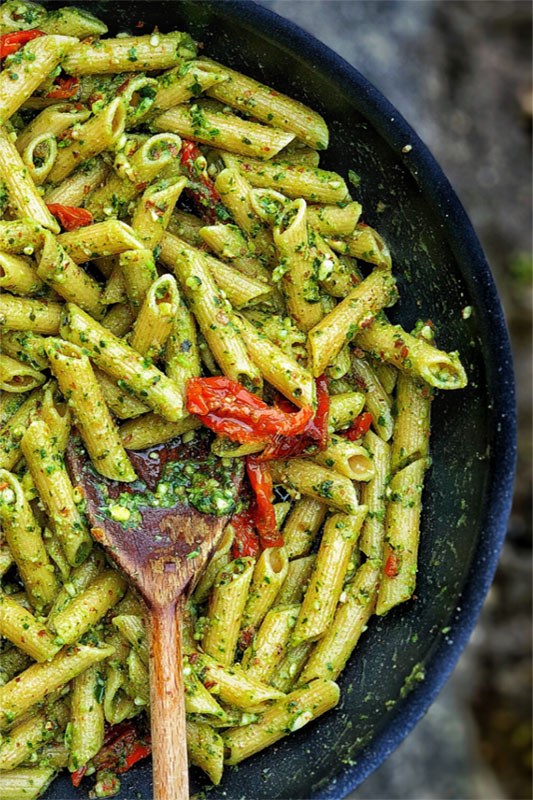
Penne – a small tube-like pasta with pointed ends, as they are cut at an angle. A very versatile pasta that holds its shape well in virtually all dishes. Widely available in wholemeal varieties.
Fusilli – thick, spiral-shaped, bite-sized pasta shapes. It is often suggested to serve this pasta with pesto, as it absorbs liquids and sauces easily.
Lasagne – the flat sheet that we tend to bake with a tomato sauce and top with a béchamel sauce.
Cannelloni – large pasta tubes that are filled and baked in a sauce.
Macaroni – famously served in a cheese sauce, these are small “elbow”-shaped pasta.
Farfalle – which means butterflies, aka bow-tie pastas. They hold sauces well and you can pair farfalle with a creamy or tomato sauce. They also go great in pasta salads.
Gluten-free pasta
Brown rice pasta – it cooks very easily, doesn’t really stick together and tastes great.
Legume-based pastas, such as red lentil pasta and black bean pasta, are generally higher in protein and do have a slight bean or legume-like flavour. They make a nice change but when compared to conventional pasta, they can taste a little strange.
Buckwheat pasta – we have found that this pasta tends to stick together. It has a really earthy taste.
The Basics For Boiling Pasta
Often seen as a simple task, it’s not if you know how! There are many myths and confusions about how to cook pasta. Having spent lots of time with his Italian friend, Pietro, in Rome, Steve has learned how to cook pasta Italian-style.
Here’s How:
Often, the ratio of pasta to water in Italian cookbooks is 1:10 so if you’re cooking 100g of pasta, you should cook it in 1 L of water.
- First, fill and boil the kettle and if you don’t have a kettle, fill a pot and boil the water.
- Choose a pot that is big enough to fit all the pasta you are cooking so that it will have enough room and not stick together. A simple rule of thumb is that the pot should be 2–3 times the size of the volume of pasta you are cooking.
- Next, add salt to the water. Ideally, the water should have the same salinity as seawater; this might sound like a crazy amount of salt but most of the salt will end up being washed down the drain but lots of it will season the pasta. It will also give more buoyancy to the water so the pasta is less likely to stick together.
- Don’t add oil to the pasta! The oil will simply coat the pasta as you drain it, form a layer between the pasta and the sauce and make the sauce less likely to stick to the pasta. The pasta itself is largely starch, so it will want to stick to most sauces but if there is oil on the surface of the pasta, this will act as a lubricant, making the sauce more likely to slide off the pasta.
- Cook the pasta how you like it. In Italy, pasta is always cooked “al dente”, which means “to the bite”. Meaning that it is always slightly undercooked and has a little bite to it. When you bite into the pasta, there should be a tiny, firm bit in the cross section. If the pasta requires 8 minutes to cook, cook for 7, taste and then drain and cool to stop it from cooking more.
If you are familiar with Italian cooking, it can be very rule-oriented in its approach to food, often seen as quite rigid in what goes with what and what doesn’t go with what. As this is a plant-based course and we tend to be a little rebellious in nature, please excuse our deviations from some of the Italian rules. If we are insulting your Italian Nonna’s famous recipes, it is not intentional. We need to bring flavours from different areas!
Sample Lesson: Vegan Baking Course – Fruit Scone Framework
These framework % are so you can understand at a macro perspective the core components – they don’t scale linearly like a mathematical equation but is indicative for understanding the relationship of the ingredients.
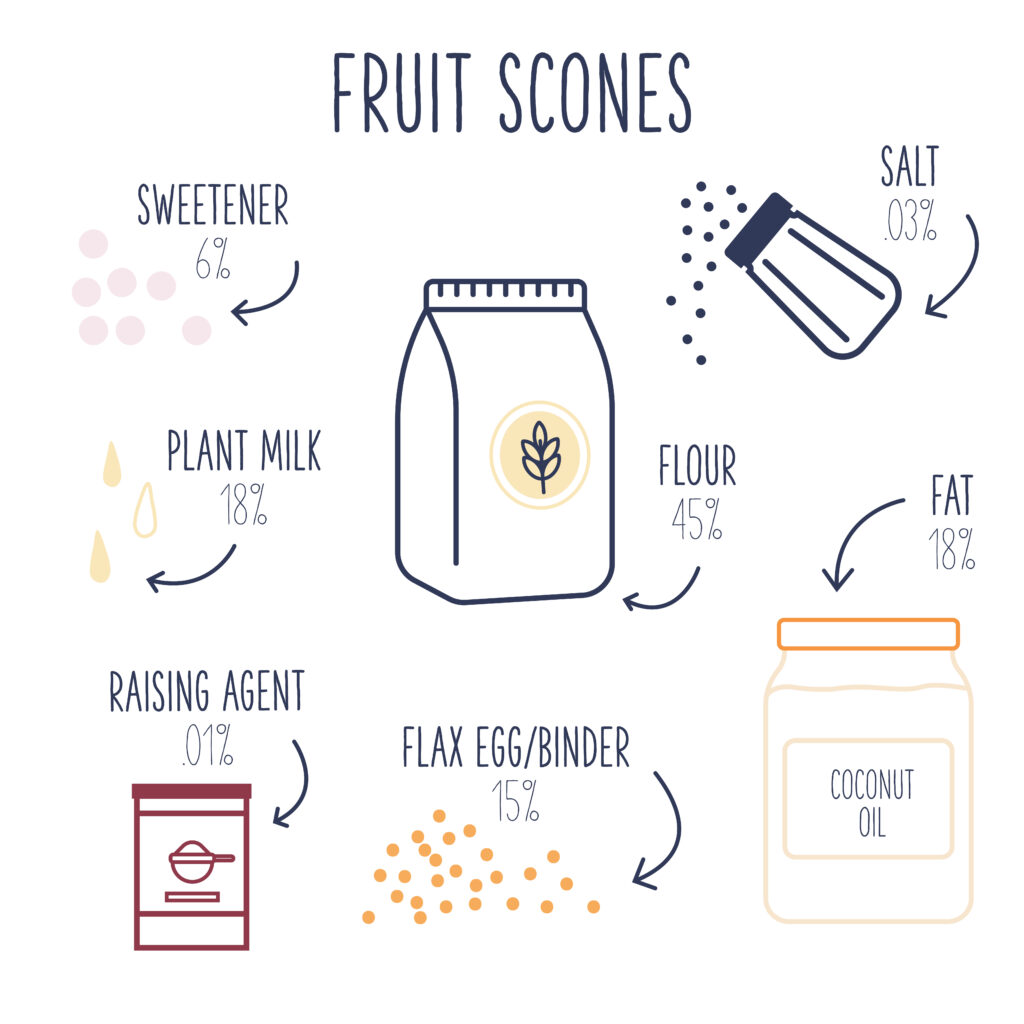
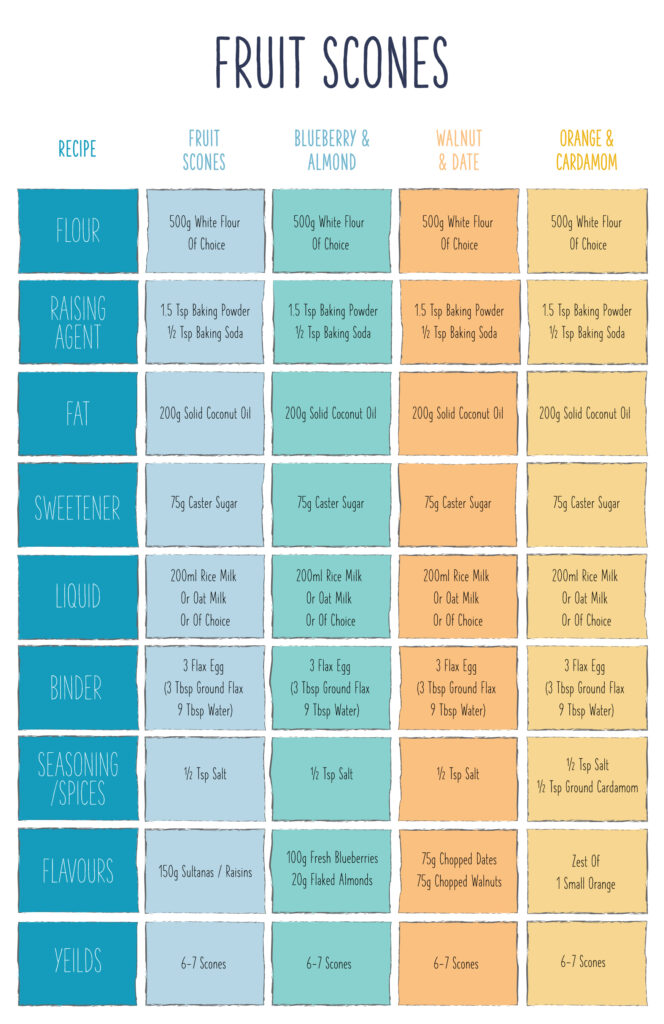
In the below framework we have 4 recipes for sweet fruit based scones. Scones are a wonderful medium which you can flavour and season in infinite ways. Here are 4 of our favourite ways.


The basic fruit scones – leave out the raisins if you prefer a beautiful white scone or else change them to your favourite dried fruit (just make sure that the dried fruit is in small bite sized pieces).
Blueberry and almond – the blueberries when baked go wonderfully purple and give these scones a lovely juiciness. Use frozen blueberries for a more intense purple colour.
Walnut & date – A wonderful chef who worked with us Claire used to make these and they were always one of our favourites.
Method
- Preheat the oven to 180℃ fan.
- To prepare the flax egg, mix the ground flax with water and mix well together, then set aside to thicken and coagulate to make the binder.
- In a food processor blend the solid coconut oil with the flour, sugar, baking powder and baking soda, salt and spice (if using any spice). Pulse it until the coconut oil is just blended through the dry ingredients evenly and it resembles a breadcrumb like texture. Take care here not to over mix the dough. If you don’t have a food processor just mix by hand ensuring to use the heat of your hands to melt the coconut oil and mix it well with the flour, sugar, salt. It should reach an almost bread crumb like consistency and have no lumps of coconut oil.
- Transfer this to a large mixing bowl.
- Next add the flavour component if using, (sultanas/raisins, blueberries, chopped dates, walnuts, orange zest etc) .
- Make a slight well in the centre.
- Mix the alternative milk and flax egg together, add to the well in the dry ingredients and with clean hands mix together gently until the dough just comes together, ensure to be light and gentle with your fingers and hands, ensuring you do not over mix the dough (as you don’t want to develop any gluten).
- Tip the dough out onto a floured surface and pat down with floured hands and shape roughly into a round shape, the height of your scone cutter. Lightly flour your scone cutter and cut out your scones, they should weigh roughly 150g each, this will give you 6-7 scones based on the above framework.
- Put the scones in a container to protect their shape and place in the freezer for 20 minutes. This may seem a little unusual, but this is the magic step that will help your vegan scone rise and disperse the coconut oil evenly while baking, giving you the perfect vegan scone.
- Transfer the chilled scones to a parchment lined baking tray (ensuring to leave a few inches around each scone to allow them room to expand when baking)
- Use a pastry brush to wash each scone with some plant milk, this will help them go a lovely golden brown while baking.
- Bake at 180℃ fan for 30 minutes on the upper rack of your oven, rotating the tray half way through cooking time.
- In the case of the blueberry and almond scones, half way through baking sprinkle over the flaked almond and leave in. The reason why we add them mid way is because otherwise they burn.
- Remove from the oven and let the scones cool for 5 minutes, otherwise you’re likely to burn your mouth!
- Enjoy!
Sample Lesson: Fermentation Course – Quick Pickling -VS- Natural Fermentation
Today, we’ll explore two popular methods for preserving and enhancing the flavour of your vegetables: quick pickling and natural fermentation. While both techniques can transform ordinary produce into tangy, acidic, delicious treats; they differ significantly in process, time, and health benefits. This lesson is quite dense so do take your time with it & if you have any queries at all, pop a question up in Tribe and we’ll get back to you ASAP!
Basics of pickling
Pickling & fermentation are a favourite hobby of Steve’s, he always has many different experiments on the go!
Pickling has been done for centuries. It is the process of preserving food by either anaerobic fermentation in a brine solution or immersion in a vinegar solution,
Pickled food via natural fermentation is a super-healthy, cheap and delicious way to enjoy the taste of fresh food throughout the year. Also there is something wonderful about making your own pickled food at home and checking on how it develops to find the perfect recipe and process!
There are 2 main methods of pickling:
– Vinegar brine method (Quick pickling)
– Natural fermentation
Both of these methods work, however, we generally use the natural fermentation process as we want to develop good gut bacteria for a healthier digestion and overall health.
What is the difference between vinegar brine pickling (quick picking) and natural fermentation pickling?
They are kind of opposites, with different advantages and disadvantages.
Vinegar brine picking (quick pickling), such as pickled red onions in vinegar, kill the good bacteria (commonly referred to as probiotic bacteria) that are necessary for fermentation, as well as the bad bacteria.
Natural fermentation pickling is a traditional method that relies on naturally occurring lactic acid bacteria. Lactic acid bacteria are naturally present on everything that grows. By creating the right selective environment for these bacteria, through natural fermentation, you allow them to feast on the sugars that are naturally present in veggies. Through this process, the probiotic bacteria that are so good for everything from digestion to immunity, grow and breed!
Quick Pickling (Vinegar Brine Pickling):
Quick pickling is a fast and easy method of preservation that involves soaking vegetables in a vinegar-based brine. This method is great for those who want immediate results and enjoy a sharp, tangy flavour in their pickles.
- Process: Quick pickling involves a mixture of vinegar, water, salt, and often sugar, then pouring it over the prepared vegetables. The jars are sealed and sometimes refrigerated, where they can be enjoyed after a few minutes, sometimes a few hours or even a few days.
- Time: Because quick pickling uses vinegar, it takes significantly less time—typically just a few minutes to a few hours to a couple of days.
- Flavour: The resulting pickles are tangy and crisp, with the vinegar providing a sharp, distinct taste.
- Shelf Life: Quick pickles need to be stored in the refrigerator and have a shorter shelf life compared to fermented pickles. The vinegar tends to break down the vegetable and when left for a long time (a few weeks) the vegetables typically start to dissolve.
Natural Fermentation:
Natural fermentation is a traditional method that relies on naturally occurring lactic acid bacteria to preserve vegetables. This method requires patience but rewards you with complex flavours and numerous health benefits.
- Process: Natural fermentation involves submerging vegetables in a saltwater brine, creating an anaerobic environment that encourages the growth of beneficial lactic acid bacteria. These bacteria convert sugars in the vegetables into lactic acid, which acts as a natural preservative. We apply a 2% salt solution method whereby you simply weight the weight of what ever fruit or vegetable you are fermenting and multiply that weight by 2% or 0.02 to get the amount of salt to add. Mix the salt with the prepared fruit or veg and add to a fermentation jar and cover with water and allow to ferment.
- Time: Fermentation takes longer than quick pickling, often several days to a few weeks, depending on the temperature and the desired level of tanginess. The longer you ferment for the more acidic your fruit or veg will become and the warmer the temperature the quicker the fermentation process will be. Similarly if it is fermenting in a cold environment fermentation will be much slower than a warm environment.
- Flavour: Fermented vegetables develop a more complex, tangy flavour that deepens over time. The process also results in a probiotic-rich food that supports gut health.
- Shelf Life: Fermented pickles can be stored at room temperature (before opening) or in the refrigerator (after opening) and often last much longer than quick pickles due to the preservation effects of lactic acid.
Comparing the Two Methods:
- Speed: Quick pickling is fast and convenient, while natural fermentation requires more time and patience.
- Health Benefits: Natural fermentation provides probiotics and enzymes that are beneficial for digestion, these natural probiotics are absent in quick pickles.
- Flavour Complexity: Fermented pickles offer a deeper, more complex flavour profile compared to the sharp tang of quick pickles.
- Storage: Quick pickles often require refrigeration, whereas fermented pickles can be stored at room temperature before opening.
Quick pickling troubleshooting
- Surface mould – Oh no! You did not submerge your veggies enough, or maybe some bits of veg floated to the surface. Best to discard and start a new batch ensuring to submerge better or get something to ensure the veg stay under water.
- The brine is cloudy – This is a good thing! Don’t worry, you didn’t use the wrong kind of salt! Fermented brine gets cloudy because it is loaded with good stuff, like lactic acid bacteria. Cloudy means it has worked. When you are done with your pickles, you can drink that stuff or add it to cold soups for probiotic punch or bread dough for flavour and salt.